 TECH DEBT CLUB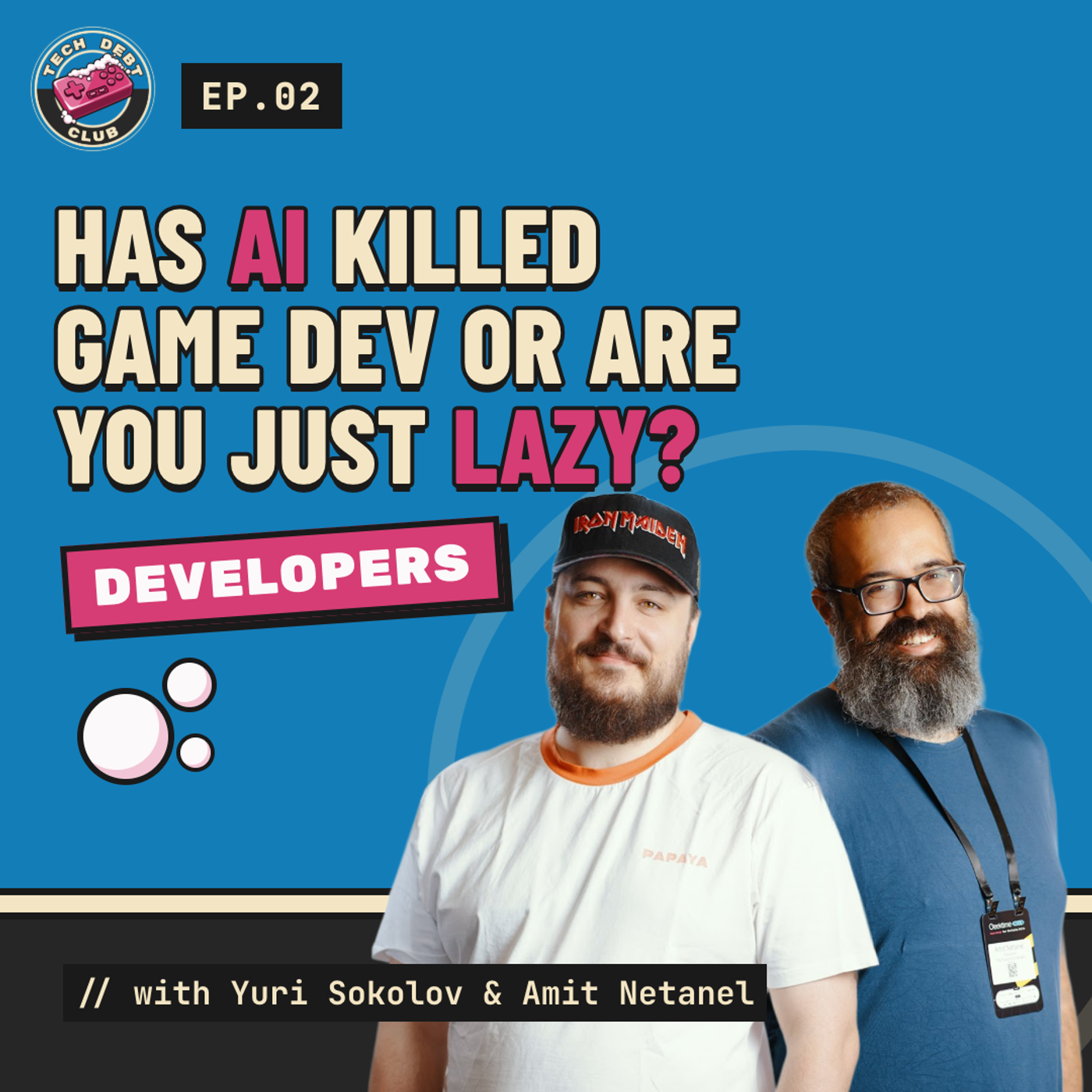
TDC #02: Has AI Killed Game Dev or Are You Just Lazy?
 YouTube
 Spotify
 Apple Podcasts
 Amazon Music
 Deezer
Show Notes
🔹 Description:
In this episode, Yuri Sokolov and Amit Netanel talk about what AI is actually changing in software and game development - and what it is not. They dig into the difference between productive and destructive AI workflows, why experience still matters when using LLMs, and why most developers and companies still struggle with architecture, tooling, and learning the right lessons at the right time.
They also get into Unity’s recent AI announcements, MCP servers, world models like Genie 3, startup culture versus corporate bureaucracy, the culture around bad practices in gamedev, and how social media shapes shallow technical opinions. Toward the end, they circle back to Bethesda-style engine hacks, AI hype in the industry, and whether AI is really replacing developers or just reshaping the work.
🔹 Chapters:
- 00:00 - Will AI take our jobs?
- 00:15 - Waiting on AI
- 01:45 - Good vs bad AI workflows
- 04:02 - AI for real dev work
- 06:13 - CAD and deterministic thinking
- 09:54 - Players want fun
- 12:46 - DI vs singletons
- 14:13 - Learning architecture through pain
- 18:56 - Startup vs enterprise culture
- 21:00 - Growing company pains
- 23:48 - Low barrier engineering culture
- 30:11 - LinkedIn brain rot
- 32:13 - Bad gamedev takes
- 36:49 - Clickbait and shallow opinions
- 39:32 - Focus and empty calories
- 44:00 - Unity AI announcements
- 45:26 - Genie 3 and AI hype
- 50:19 - Unity MCP
- 55:31 - AI for investors
- 58:13 - Where AI actually helps
- 1:00:25 - Extreme AI game jam
- 1:02:51 - AI amplifies skill
- 1:05:29 - Prompting with constraints
- 1:08:43 - Debugging with AI
- 1:10:29 - Fallout 3 train hat
- 1:12:55 - Bethesda engine hacks
- 1:15:18 - Building while AI works
- 1:17:59 - AI changes the work
- 1:19:01 - Is programming dead?
- 1:21:51 - Build vs buy
- 1:23:31 - SaaS needs real value
- 1:26:27 - Losing knowledge to AI
- 1:28:07 - Seniors using AI badly
- 1:30:24 - Could AI replace devs?
- 1:31:50 - Layoffs and AI optics
- 1:33:35 - Unity promises
- 1:35:47 - Wrap-up
Yuri Sokolov (00:00)
do you think AI will take our jobs?
Amit Netanel (00:02)
programming is dead. We won't need people for this and that.
Yuri Sokolov (00:06)
I think it's midlife crisis.
Amit Netanel (00:08)
It's important to see silly cat videos on the internet.
Yuri Sokolov (00:12)
Nobody cares about unit tests. Nobody cares about this stuff.
Amit Netanel (00:15)
I feel like I've lost something. I used to be able to do that and I think I lost it. OK, I have a question. I have a serious question. What do you do while you're waiting your prompt to be analyzed and responded to? Any prompt, if you're using Cursor, if you're using any other ⁓ LLM interface, what are you doing? You don't have any control over how long it will take. It could be five minutes. It could be 10 seconds. ⁓
Yuri Sokolov (00:26)
and What I do when I... Okay, it depends. It depends. So I have a couple of flaws. One is destructive. One is super productive. The destructive one. The destructive one. So sometimes when I'm using ⁓ LLMs to fix small issue in my current code or help me debug or I don't know, make some adjustments ⁓ in unplanned fashion.
Amit Netanel (01:01)
I guessed as much.
Yuri Sokolov (01:25)
Why I'm calling it destructive method is because I'm writing and going to another virtual desktop and ⁓ starting browsing the internet, watching videos and suddenly a five minute.
Amit Netanel (01:33)
Mm-hmm. Yeah, no. Yeah, yeah. You're kind of destructive, but I guess 90 % of our viewers slash listeners are doing the same thing.
Yuri Sokolov (01:45)
Yeah, and suddenly a five minute tasks that could have been 10 minute task if I was doing it myself. It turns into a 30 minute task because I found the perfect video that just 30 minutes long. And this is the destructive method. But I have really productive method of working with LLMs. So basically I have multiple Docker instances on my computer.
Amit Netanel (01:53)
Mm-hmm.
Yuri Sokolov (02:14)
that are running the environments with all the prerequisites I need for my project. And I can start working on product descriptions. It's more, it's less of a software engineer work. It's more of a PM work. I'm writing in GitHub. I'm creating issues in GitHub and my queries, I'm managing multiple agents at the same time. I'm just... writing to the agents, take this issue from GitHub and implement it and create a pull request. then usually, because, you know, when you're working with Unity and stuff like this, it's a bit heavy to have multiple instances on your single computer. So I'm trying not to overdo it. I'm like working with two, three agents at the same time. And what's happening is, well, one or two agents are working. I'm reviewing the code of the third agent. So even though I'm using AI generated code, every line of this code is accounted for. I'm actually going line by line. I'm forcing other LLMs to review this code as well. So there's a feedback loop between them and then I'm entering the field. Sometimes I'm fixing things manually. Sometimes I'm telling the AI to fix things. So basically what I do is most of the time I just jump from one agent to another until I run out of tokens.
Amit Netanel (03:59)
And then you have your really destructive break.
Yuri Sokolov (04:02)
No, and then I'm thinking, okay, I earned this. But usually what I do, because currently I have actually a lot of work, so what I do is just starting to write descriptions for next features, next stuff, because I'm managing my own product. There is no product manager that will come, there is no game designer, there is nobody. doing everything myself and I'm starting to write some stuff that should go into the work. while most of my multi-agent work is not really related to, directly related to a game development, it's mostly around this area. It's backend related and sometimes features. So I'm working in Unity not only for game dev. ⁓ Some of the animations in my channel are built inside Unity. And this is the perfect place to use LLMs because you just don't give a damn about the quality of the code. You just, okay, I need this feature. So I've built myself a custom animation framework I'm using. ⁓ If you'll take any animator out there, he will say that it's really really bad. It's an animation system for a software developer that is particularly me, not anyone else.
Amit Netanel (05:41)
Yeah, you're not developing a product for an animator. You're doing something for yourself. It has to look good once, maybe over several. Because I know you, you're kind of a perfectionist. So you'll need several cycles of, ⁓ yeah. But yeah, you're going to have a few cycles of feedback for yourself. But nothing like, you don't need a timeline or.
Yuri Sokolov (05:52)
Mm-hmm. Perfection is that never reaches a perfection. That's that's the correct term
Amit Netanel (06:10)
like really heavy editor facing software.
Yuri Sokolov (06:13)
Yeah, I prefer doing things in a more structured way. Okay, so you can take it this way. I'm the one, I'm the person that will take a CAD software over a 3D modeling software. Because I prefer, if I need to model a chair, I know that the size of the seat is... Approximately 40 centimeters by 40 ⁓ and if we're talking CAD it's 400 by 400 and not 40 by 40 and it's not inches it's centimeter millimeters to be exact and I'm starting to work with those numbers. I can't It's really hard for me. It's painful for me to start to open blender and say The chair is roughly the size of my fist when I'm looking from this distance to the screen.
Amit Netanel (07:13)
Yeah, you don't work by feeling. You work by exact measurements. You have a process after that. You were the one that ⁓ recommended Fusion for me because I started learning 3D printing just on my destructive brakes, by the way. That's what I'm doing. I'm fiddling around with 3D stuff. I'm relearning Japanese. I have many, many tabs that I cycle through while I wait for Cursor to finish his Uber Max multi-agent super task. I send him off.
Yuri Sokolov (07:16)
Yeah. Mm-hmm.
Amit Netanel (07:43)
off of two. And the fusion approach to modeling is really interesting because it makes so much sense. Yeah, it's parametric definition of what you're trying to achieve. The fact that you can go back to any step of the process and change one measurement or one step is quite amazing. But it's really different from how I imagined 3D modeling to be like sculpting in 3D space.
Yuri Sokolov (07:51)
because it's not modeling. That's procedural generation for you.
Amit Netanel (08:13)
And it's definitely not that.
Yuri Sokolov (08:14)
So now, in 3D, even if you're taking CAD out of the way and you're concentrating on 3D modeling, there is modeling and there is sculpting. So you take applications like ZBrush, which is primarily sculpting, and then you have any other app that can do whatever, right? In ⁓ CAD's world, so Fusion 360, AutoCAD and any other CAD you can think of, it's different. It's more procedural generation based on your input, based on your sketches. So it's really nice what you said that you're building a timeline and everything deterministic. So you can change one step and... most of the time the steps that come after the step will adapt. And this is actually something that is heavily used in other tools for VFX ⁓ in the industry, in game dev industry. And when you're developing a game, it's really, if you're having a deterministic world that is procedurally generated, you can have so much fun in your games. ⁓ replayability ⁓ or competitiveness of the game.
Amit Netanel (09:42)
And you can also be certain that things won't easily break, because you have control over the knobs you can turn to make the actual content. ⁓
Yuri Sokolov (09:54)
But nobody cares about that. People care about fun, right? Nobody cares about a good quality code. Nobody cares about unit tests. Nobody cares about this stuff. People want fun, beautiful games.
Amit Netanel (10:08)
I mean... I
Yuri Sokolov (10:12)
you know, fun, beautiful games build themselves, right?
Amit Netanel (10:13)
they do want... Yeah, and they also do it really fast, because these things don't go into making stuff faster, right? Like building all the infrastructure right, having unit tests does not factor into actually fixing stuff eventually. Yeah, people don't see. If people don't complain about stuff, you know there's something complex going on in the background that keeps them from complaining about that stuff. At least that was my experience so far.
Yuri Sokolov (10:47)
But you know what? From my experience, if you have one thing, if you have an opinion on something, ⁓ and if you are a developer and you have an opinion on something, be sure that there's a lot of people that have an opposite opinion and you're gonna fight. So it doesn't matter what you're actually believing, ⁓ there will be a ton of people that won't agree with you. for example, we prefer dependency injection frameworks and not singletons.
Amit Netanel (11:25)
dependency injection. What's dependency injection? I didn't talk about it today yet. ⁓
Yuri Sokolov (11:28)
Currently, I don't know how many people watching, 10, 5. Currently, half of those people are telling, what the hell is dependency injection? Just use singletons. there are also people on the other spectrum. So it doesn't really matter. ⁓ If it works for you, then it works for you. It's awesome. At the end of the day, a great, ⁓ great... suggestions ⁓ I once heard was ⁓ nobody will look at your code at the end of the day. Nobody will say, ⁓ do you remember this Expedition 33 game? What an amazing naming convention they had. Nobody will say that.
Amit Netanel (12:15)
Even more so today, by the way. Less and less code is being reviewed and written by humans. So even your colleagues might not appreciate what you're doing. ⁓ Yeah, people remember the fun, the stability, or lack thereof. They remember experiences. So everything we do when programming, Vibe coding, ⁓ it should serve
Yuri Sokolov (12:28)
⁓ yep.
Amit Netanel (12:46)
Like, it doesn't matter if you use Singleton or DI if the game is fun, which is a shame. ⁓ But just so you know, I have lots of thoughts about this. Because when I was a I'm still doing it, by the way. I'm advising some companies as clients regarding coding architecture. ⁓ Recently, there's a huge demand for information about AI stack, what AI tools they should implement in their stack and what skills do you use on your day to day? Write your own goddamn skills. That's the TLDR of those meetings usually. So there is a lot of, I managed to see lots of company DNAs over the last, I say three, four years. And it doesn't matter how
Yuri Sokolov (13:14)
AI. Mm-hmm.
Amit Netanel (13:44)
much I advertise the benefits of DI and clean code. And I teach about the domain architecture I use in glaive games. And you've used with me before in several projects. It doesn't matter how much I stress the benefits from that. If that approach doesn't click with someone, they won't use it. OK, it's maybe ⁓ it's almost like a religion of sorts.
Yuri Sokolov (13:58)
Mm-hmm.
Amit Netanel (14:13)
People hold these opinions very tightly. And that's part of the character of that company, part of its, you can say, character, DNA, whatever.
Yuri Sokolov (14:13)
It's not a religion, I think. I don't think it's that. I just think that... Okay, so currently I'm working on a series of videos for my channel that trying to navigate architectural issues, trying to teach how to think in terms of architecture. And what I came up with after... After releasing, I don't know how many videos, 30 videos, 30 learning videos and doing other teaching stuff, I think the issue is people often thought ⁓ design patterns or architectural patterns before they encountered the issue that those design patterns solve. So I can tell you that, ⁓ singletons are bad because they, you pull globals all over the place and it makes the code less readable and you can't unit test it. But for a person who ever worked in a small teams on the project that starts and ends at the same fiscal year, ⁓ it's not an issue. It's not an issue that he can't. do unit tests. He doesn't need it. He never needed it. And if I'm coming and saying to him, you know, singletons are bad because you can't unit test it. Whatever. I don't need it. So in order to teach architecture or to teach benefits or of some approaches, you need to introduce the problem to the person, something that he encountered
Amit Netanel (15:57)
Mm-hmm. Mm-hmm.
Yuri Sokolov (16:24)
in his daily life. I released a lot of videos that come from a different perspective, not looking at it in the correct perspective, I think. I think I did a lot of mistakes with those videos because again, I'm starting to teach people things that I think are good, but those people saying to me, we don't need your good. We never experience the issues you're talking about. So... What the hell are you talking about? And currently I'm working on a series of videos that should, at least I'm trying to connect the dots, to push things down your trough and this is the design pattern that you should use. No, I'm trying to take you by the hand and show you, you see, we do this like this.
Amit Netanel (17:22)
Mm-hmm. Yeah.
Yuri Sokolov (17:23)
And then it breaks. You see what broke? Let's try to fix it. And then we fix it. And the fix is still not good enough because it breaks something else. And I'm trying to take you by the hand. I don't know how good it will turn out. I have already scripted a lot of videos and a couple of them are recorded already. One is going to be released next week, I think. So let's see. But the fact that you're advertising... those things again you're coming to someone who haven't experienced yet the pain points you're trying to talk about and then why do I need now to spend I don't know a week learning something that I don't see
Amit Netanel (18:08)
You're really generous with people wanting to spend a week learning. They don't want to spend the three hours learning. And that's the real issue, which is totally understandable. I don't want to sound too condescending, because the clients I tend to work with have a strict deadline, and they want to deliver something, which is the worst kind of environment for learning. They want to deliver something. They need to raise money, raise capital, and stuff like that.
Yuri Sokolov (18:22)
Mm-hmm.
Amit Netanel (18:38)
And they don't necessarily need the entire solution that will help them grow from two people studio raising seed or round A into a 400 people company. They don't see that transition yet happening. And that's the thread.
Yuri Sokolov (18:56)
Did you notice that there, is no middle ground. is no, it's basically, it's always the startups that are constantly running after, ⁓ after the investments and they don't have time. Everything has to be fast. We don't have time to learn. don't have time to make a proper architecture. We don't have time for anything because every hour we're wasting time. We're losing money, ⁓ money that we don't have money that somebody invested in us and
Amit Netanel (19:07)
Mm-hmm.
Yuri Sokolov (19:27)
we have to run fast. And then ⁓ either the startup fails or whatever, or it becomes, it turns into this massive behemoth that, okay, now we can take everything slow and things become ultra slow. want, ⁓ you wanted a new chair. Okay, you have this 15 forms to fill and then you have to mail them to those 16 addresses. Yeah, that's right, 15 forms.
Amit Netanel (19:55)
No problem. You're going to have your chair in two to three quarters. No problem.
Yuri Sokolov (20:00)
Yeah, I just recently listened to one podcast and the guys there talked about I think it was about ⁓ Wargaming that Wargaming tried to create a publishing studio for indies, something like this. And Wargaming is a huge company that has... it's a corporate already, right? they started communicating with Indies in terms of next month, next quarter. In this period of time, Indie companies born and they die.
Amit Netanel (20:44)
Yeah, they do like 20 pivots and ⁓ do several internal game gems to figure out what game they're going to do.
Yuri Sokolov (20:51)
Yeah, in between two emails of inside a corporate indie company can become successful or unsuccessful.
Amit Netanel (21:00)
Yeah, but you know why you think that dichotomy exists? Why do you have only startups and huge monolith behemoth companies? That's because the middle period is the most tricky. What I've grown to learn is that it's the worst place to work at while the transition happens. Because you have some side effects from getting money and growing. It's called growing pains. for a reason. And it's really difficult to survive that transition and do it well with the same people. I worked in several companies that had their old guard, like people that were there in the beginning, dictating decisions and holding back the growth of the company. ⁓ And I was in the opposite situation, like, where they fired all the old people because they wanted the DNA of the company to be different. And that worked actually pretty well for them in the end. One of the best cybersecurity companies. I'm not there. didn't see a dime from there being really successful. I was there ⁓ when they were like 20 people in the basement, which was fun. It served lots of purposes in my life then. But... ⁓
Yuri Sokolov (22:02)
Mm-hmm.
Amit Netanel (22:24)
It's a completely different creature now. They came out of their proverbial shell. I don't know. But ⁓ the real tragedy, I want to step back a few steps in our conversation. The tragedy of trying to teach people advanced tooling is that they have to know and feel the pain before you give them the medicine. They don't know. They won't buy anything you're selling that has ⁓ a good value on the long run before they know what it means. And knowing what it means is experiencing the difficulty. And you and I talked about this many times on, what tools and what infrastructures we can create as content creators, as teachers, podcasters. What environment fosters this kind of, ⁓ you know, ⁓ baptism of fire. How do you make someone encounter the issues, and then you teach them the right tool to overcome that issue, and over time, they will ⁓ get it? That's the process ⁓ of someone ⁓ working in a company. It's not something that's easily reproducible in a video.
Yuri Sokolov (23:48)
I'll tell you what, I'll tell you what, I think it's really related to ⁓ a culture surrounding the technologies that you're using. And hear me out. So when I started out as a professional developer, ⁓ my first gig, 15 something years ago, ⁓ was a PHP developer. At the time, PHP was everywhere. Every website was built... in PHP and the entry level was so low that every college student or even school student could build a website. And now those guys that just finished high school, they would say, ⁓ I'm a programmer. Take me. And The high-tech back then scaled quite good and a lot of them were hired. And me included, I was able to find a job as a PHP developer without any, you know... any place I've never learned in any college or you know I don't have a degree and back then you could this was the only way to get into software development without college degree and ⁓ if you were a C sharp developer you had to have a degree to enter now I'm not saying the degree is great or degree is bad. But what I'm saying is that most of those PHP developers back then were writing single page application. So your whole website was built in a single file, in a single PHP file. And when you were looking at C sharp code that back then with ASP.net tried just started to, you know, try to force their way into web development. They tried to compete with Flash, with their Silverlight. They tried to compete with PHP, with ASP.NET. But the developers, the C-sharp developers, the Java developers back then, they had class, let's say it like that. They've known their object-oriented code, while PHP back then...
Amit Netanel (26:14)
Yeah, it was multiple fronts advancement back in the day.
Yuri Sokolov (26:34)
When I started working on PHP, it just started the transition to an object oriented language. It wasn't object oriented, it was like JavaScript. So PHP also had this transition like JavaScript that transitioned-ish into TypeScript, which is still two different languages. PHP remained the same language, but you can use it in two ways. And by the way, C Sharp right now transitions the other way around.
Amit Netanel (27:03)
Yeah, it has the other way. It goes the other way around to lure younger audiences.
Yuri Sokolov (27:04)
Yeah, C Sharp transitions into a scripting language. Yeah, it's not only for that, it's mainly, I think, to compete with languages like Python. ⁓ It's mainly for this purpose. So then I saw the similar thing in Game Dev. Many, many years after, Unity came with an easy entry point.
Amit Netanel (27:16)
Bye then.
Yuri Sokolov (27:32)
don't need to be a software engineer per se to develop games in Unity. You can just come, learn a thing or two, let's call programming scripting. Now it's not programming, it's scripting, now it's not code, it's scripts. And you just drop your scripts, your behaviors on game objects and everything works. And this kind of...
Amit Netanel (27:55)
You don't have to write the entire engine to make a game, which is huge. It's huge.
Yuri Sokolov (28:00)
Yeah, yeah. And an entry point into this became so low that a lot of people, non-engineering people, entered the game development world. And while, again, a lot of good games came out with horrible code, that's fine. There are cases like game as a service, mobile games, that live for years. with tens of developers contributing daily into the code base, those games need good engineering and they didn't have it back then. While the other coding community had it, they could write great code. So now you have this culture and I'm bringing back the idea of culture inside your development environment. You have this culture of people that, ⁓ okay, we're used to one thing and every possible tutorial out there is telling us how to use singletons. Every possible tutorial out there ⁓ is using getComponentInsideUpdate method or whatever. It's just in the culture. You don't have it in traditional programming. Go find... Go find any, any, I don't know, C++ developer, Java developer. ⁓ Again, C++ developer are different breed. No, not rare at all. They're just different breed because there are a huge following of functional programming among C++ developer. Something that I don't really like, but I can't say they're...
Amit Netanel (29:37)
rare these days You're saying they exist but they have their own tribes They don't meet the outside world as much
Yuri Sokolov (29:58)
Yeah, yeah, yeah, they have their own civil wars they're fighting, so no need to fight with them.
Amit Netanel (30:04)
Mm-hmm. okay, they don't argue on LinkedIn, you mean.
Yuri Sokolov (30:11)
Probably... No, they do, they do. I often see a lot of posts on LinkedIn. And by the way, the posts on as a social network is the funniest social network ever. Because everybody writes stupid stuff and everybody understands that they're writing stupid stuff. And they continue to do it. It's...
Amit Netanel (30:39)
Yeah, actually a tangent about that. ⁓ My partner overheard me and another friend, another programmer friend talking about how we hate LinkedIn these days and that we don't enjoy the posts. We don't enjoy posting. We don't enjoy liking. We don't enjoy, we don't get anything from it other than, you know, complaining about it. And she asked, why are you doing it just to complain? And I figured out, yeah, right there and there.
Yuri Sokolov (31:02)
Mm-hmm.
Amit Netanel (31:09)
That's the service I'm getting out of LinkedIn these days. I'm getting annoyed at stuff, and I'm doing annoying things to be a part of the conversation. So it's an annoyance-based social network, if you will. That's my experience with LinkedIn these days. You're much better on LinkedIn, by the way, than me. I'm just a passive hater, and you're actively participating in creating content. And the...
Yuri Sokolov (31:17)
Yeah, and then when you're looking for a new job. in making other people who hate me. Yeah.
Amit Netanel (31:37)
pretty much, but they also like you because you increase the engagement. So they need your hateful comments. And by the way, you're exaggerating. You're not writing any hateful comments. You're challenging them.
Yuri Sokolov (31:47)
No, no, I'm not writing hateful comments, but sometimes people think I do. And let's get back...
Amit Netanel (31:54)
No, no, think what you're doing, yeah, yeah, just to finish that, what you're doing is challenging the posts, the pretty bow people tie around their posts. And that's annoying, but it's driving conversation. So that's an interest of people, I think.
Yuri Sokolov (32:13)
I'm actually, what I'm trying to do, I don't try to offend people. So I'm not trying to turn LinkedIn into Reddit where people just drawing ⁓ stuff at you just for, for the fact that you're having a different opinion. What I'm trying to do, sometimes I would see a post on LinkedIn that suggests some, I don't know, let's call it optimization technique or a coding hack.
Amit Netanel (32:27)
for the lolz.
Yuri Sokolov (32:43)
or whatever and I noticed that the suggested approach is let's say an anti-pattern or a bad practice. So not everything you can do you should do. Right? You can do a lot of stuff ⁓ that you shouldn't in real life or in coding. And we as a community, as a gamedev community, I don't want to say suffered because we're At the same time, we benefited from it. From a lot of easy tutorials that teach not necessarily correct approaches, but those tutorials had their benefits when they were out years ago that helped us build a huge game dev community that helped us helped develop Unity as an engine. And thanks to that, I have a job today, right? And but today is different. Those they are back then. There is no reason to continue promoting bad practices. And sometimes I see people do that and I'm just not I don't want to say I'm calling them out. I'm just going and try to correct the approaches. Right. I don't know if I should do this because it seems to me that on LinkedIn. LinkedIn as a social network, it's the only social network that exists for you to post, not to read. people not, people, it reminds me of the early days of Facebook when it just got out, that ⁓ when somebody would write something on Facebook, everybody would, everybody who was your friend on Facebook would go and like your post.
Amit Netanel (34:17)
Mm-hmm.
Yuri Sokolov (34:36)
and say how beautiful you are, how smart you are or whatever. It's not like that today, right? It's more opinionated.
Amit Netanel (34:47)
Excuse me, I had to try and remember what's Facebook like when you said it. The neuron was activated. It was just delayed.
Yuri Sokolov (34:51)
Ha ha ha. The hipster in you... Okay, I'll translate to the hipster in you. It's like mustard on for old people.
Amit Netanel (35:02)
⁓ yeah, Mastodon. Wow. That's the cool new thing. By the way, I left Mastodon and Blue Sky already. Not to another hipster network. I just don't talk with anyone. That's the next evolution in the hipster. You have the monkey and then the man ⁓ walking away from his monkey nest, then going on the computer, and then sitting alone in a room, which is my life right now. ⁓
Yuri Sokolov (35:06)
Yeah. Mm-hmm. Don't we all? I think a lot of people can relate to that. A lot of people in especially in software development industry can relate to that. ⁓ In high tech in general.
Amit Netanel (35:41)
I still read Hacker News daily. I log into Hacker News. I see what's the plat de jour, what's the new AI tool everyone is complaining about. And that's enough for me because I actually get value from Hacker News. I go into rabbit holes. I search the web for stuff I read there. And I really want more actual value stuff. I don't want to click on click baits anymore. don't want to. I have a good friend. OK, that constantly opens in between tasks. Or even when we're hanging out, he opens Google Chrome on mobile. And ⁓ by default, Chrome has ⁓ a list of stuff you'll be interested at. OK? And he skims the headlines. And sometimes he quotes stuff from there. And it's obvious that these articles are meant to give you something to talk about something.
Yuri Sokolov (36:17)
Mm-hmm. Yeah, yeah,
Amit Netanel (36:41)
sensational you want to click on. ⁓ sometimes he forms his own opinions based on only on those titles, like. ⁓
Yuri Sokolov (36:49)
There are a lot of people that form opinions based on titles and I suffered from this in my work from people that approach learning. So you come and you introduce a new idea. Say, okay, I've read this article, I've read this book, I've seen this, I don't know, video and here's the thing, it's a... I don't know, an infrastructure, an architecture, tool that we can use. And then the guy that's responsible for the decision making reads one or two lines of this article slash book slash video, I don't know, whatever, forms an opinion based on the title, ⁓ on the hook, which is in... ⁓ I don't know if it's a thing, at least in places I've been as a content creator, it's a thing. There is a clickbait and there's truthbait. So basically truth clickbait is ⁓ a title that serves only one purpose, to make you click. It doesn't matter. it can be whatever.
Amit Netanel (37:54)
Mm-hmm. Mm-hmm. to reel you in on the content.
Yuri Sokolov (38:12)
You won't believe what she said to him. And then you open the article and the article about, I don't know, And truth bait is when you're telling something about the content that person is about to receive and, um, but not telling everything. So you're playing on his curiosity and you're saying, okay, I did example of truth baiting. I wrote three lines of code and it completely broke my program. I don't know. And you're telling the truth. You did those three lines of code and it broke your program. And now if you're interested to see what were those three lines of code and what actually broke, come and see. Yeah, yeah, So you're telling the truth about the content the person supposed to receive. So it's not really a clickbait. And
Amit Netanel (39:01)
What's the actual context? Yeah, what's in it for me?
Yuri Sokolov (39:11)
A lot today, a lot of people are confusing mixing up those things and basing opinions on software architecture or anything in life based on titles of click baity titles is just horrible. It's
Amit Netanel (39:32)
That I want to circle around to, I see the theme of our conversation is learning and making yourself a little bit more knowledgeable at the end of the day. And ⁓ all these truth baiting and click baiting and social networks are indicative to like a common state of mind that's around, that's not conductive to learning. We started this conversation. asked you what you're doing while you're waiting for your prompts to run. And you said that when you're alt tabbing into your browser, you're destroying your time. And sometimes it's important. OK, let's caveat it out of the way. Yeah, it's important to rest.
Yuri Sokolov (40:16)
Mm-hmm.
Amit Netanel (40:22)
It's important to see silly cat videos on the internet. It's really important for the human soul. I get it. But you can't do it most of the time, OK, because you're going to ⁓ It's like empty calories. You're going to not develop out of it. And most people will burn out of it even if their goal is not to be the best programmer to make the best game. They just want an honest day's work. They're going to feel something is missing. And I think ⁓ that the ecosystem around us is leading us in that direction. And we have to actively try and think of, OK, how am I
Yuri Sokolov (40:35)
Mm-hmm.
Amit Netanel (41:00)
doing something that's constructive, that's conductive. So I shared with you before the stream that ⁓ I want to go back and watch tutorials like they used to and to force myself to watch straight 30 minutes of someone sculpting a chair in Fusion and to try and learn from that, to reactivate the neuron structure of focus in my brain.
Yuri Sokolov (41:05)
I don't think we necessarily... ⁓ I'll ask you another question. Why? Why do you have to force yourself to do that? If it doesn't work for you, then it doesn't work for you.
Amit Netanel (41:39)
because I feel like I've lost something. I used to be able to do that and I think I lost it.
Yuri Sokolov (41:45)
I think it's midlife crisis.
Amit Netanel (41:49)
Could be, could be. And it's way better midlife crisis than, I don't know, owning a boat or a motorcycle or something like that. Running a marathon. Yeah, that's the, ⁓ some people have that midlife crisis at 20. That specific one you said.
Yuri Sokolov (41:57)
or deciding to quit a job to build an indie game? No, at 20 it's not midlife crisis, at 20 it's the best age to do that. You don't have a family, you don't have responsibilities, you don't have to earn that much to, you know, so your time is a little less expensive. So 20 years old is, it's like, you know, 20 years old, you know nothing, but you have all the time in the world and then... ⁓
Amit Netanel (42:17)
Definitely. Definitely.
Yuri Sokolov (42:40)
30, 40, 50, you know, you know a lot of stuff, but you don't have time to do that.
Amit Netanel (42:45)
Yeah. Yeah, it's a tragedy. It's the tragedy of the human race, what you've just described. Because now I understand how much time I used to have, and I'm rethinking what I wasted it on. Sometimes I wasted it. Sometimes it was worth it. But, ⁓
Yuri Sokolov (42:49)
Yeah. Yeah, I think, I think. I think the best case scenario for humanity would be if we all lived the life of Benjamin Button. we would start, ⁓ you know, receive, yeah, yeah, yeah, we would burn old, receive our pension and then ⁓ do whatever we want. And then we start working. We start working.
Amit Netanel (43:16)
as an old, really old baby.
Yuri Sokolov (43:30)
A little bit because we're old, we can't work too much. And then as we get younger, we'll increase the load, we'll earn money. And then when we have enough money and we're really young, we can start having fun. This could be the ultimate life experience. But if everybody doing it together, not in a bunch of... Yeah, yeah, yeah.
Amit Netanel (43:33)
Yeah. Yeah, if you're not a freak. Yeah. Yeah. So.
Yuri Sokolov (44:00)
Speaking about AI, by the way, we mentioned a of things a couple of times here. Have you seen the Unity announcement, pre-GDC announcement of their AI tools?
Amit Netanel (44:12)
No, no, no, I'm not following the stock as closely as you my day trader friend so
Yuri Sokolov (44:18)
No, thing is that, okay, stock, right. I think everybody heard the situation with Unity when they first dropped their stock because Google apparently created the next big thing in game development and introduced world model. my God, the people responsible for our money.
Amit Netanel (44:37)
Yeah, yeah, yeah.
Yuri Sokolov (44:47)
No nothing, apparently.
Amit Netanel (44:49)
It looks like every time someone in Unity opens their mouth to speak, it doesn't matter what they actually say and what the graphs of the KPI's of Unity say. Every time they try to say something, the stock drops. I don't get it.
Yuri Sokolov (45:04)
Nah, it's not that bad. By the way, their current CEO, I think, did a great job. ⁓
Amit Netanel (45:11)
Yeah, it's not related to what he says. He says great. I think you're going to talk about what they announced. And you've spoiled it for me when we talked on WhatsApp earlier. And I think it's great. But it doesn't matter that it's great. Like, people. OK.
Yuri Sokolov (45:26)
No, I have another opinion on this. So basically if we'll track the timeline, ⁓ Google announced how their world model called. I don't remember, I even don't remember the name of the model. Okay, so they dropped their world model, which is not game engine and bunch of suits.
Amit Netanel (45:40)
Me too. I can remember.
Yuri Sokolov (45:51)
freaked out, ⁓ now Unity is obsolete, we don't need Unity or Roblox or whatever. Google will, people will generate games from prompts and so Unity dropped a lot of stock. And then again, then was the thingy with the end of year when they reported the end of year, the end of year was great, but their projection towards Q1 was not so great. I'm not going into that. It doesn't really matter. ⁓ So you feel at this point that Unity start to rush their AI race. They had some tools and underwhelming tools to be...
Amit Netanel (46:33)
Mm-hmm. They had Unity Muse which was amusing but not really production ready
Yuri Sokolov (46:44)
They rebranded it into Unity AI. could, so for example, I'll tell you, I've tried a couple of those tools. They gave free credits. I haven't used the free credits. You know, it was underwhelming to say the least. So it was really basic and ⁓ they used, I would assume they used not their proprietary LLM models. They used partners.
Amit Netanel (46:58)
Mm-hmm. Mm-hmm. Me too. Me too.
Yuri Sokolov (47:12)
For example, for sound they probably used 11 Labs or something and for 3D ⁓ mesh generation they used probably Mesh or Rodin AI or whatever. I don't know. So it was underwhelming. And at the point that there's stock drops, you see the rush to, now we have to make... the next big thing with AI. We have to show the world that we're relevant. And okay, the CEO comes and says something in the scope of, at GDC, we will announce an AI tool that will allow people to create casual games from prompts. So without anything at all is explicitly says not full games, not full indie AAA games or whatever. once again, some people, I have read how people understood it, some people have issues understanding the text they read, so they assumed he meant that that's it, the game is over for game developers, AI will do everything, it's not. It's probably related to the things he tried to convey. You're gonna be able to generate a full, you know, casual game, mobile casual game, a small game with a simple mechanic that can be used as a prototype. Yeah, it's awesome for prototype use. then they said, you know what, you don't have to wait till GDC.
Amit Netanel (48:50)
You're going to be able to prototype, prototype really, really fast.
Yuri Sokolov (49:07)
Why don't we show you a couple of days before GDC what we came up with? Said, well, they probably want to get their stock up. And somehow I've missed the time they started the stream, the pre-GDC stream, and the trading started and I get an alert that Unity stocks dropped 5%. Okay, let's see what's happening. And then I noticed the date I say, there, was a stream going on. I opened the stream. I'll see. I, I hope they haven't talked about AI yet, because if they talked about AI and their stock continued dropping, it's, it's an issue. And they already talked about AI and probably people expected from this talk to be something amazing, overwhelming and It wasn't. They introduced a couple of useful things. For
Amit Netanel (50:11)
OK, so let me just cut you real quick. I looked for the name of the world model. It's called the Genie 3, and it looks amazing. Looks amazing. So maybe the stock drop is OK.
Yuri Sokolov (50:19)
Yeah, yeah. It's... No, no, no, we can talk about this, but let me get back to their AI announcement. So, MCP, I'm sure you know a thing or two about Unity MCP because you were one of the people that developed your own MCP server, right? For Unity.
Amit Netanel (50:33)
Yeah, sure. Go ahead. Yeah, it started as ⁓ a side project just for curiosity, because people started talking about it in Hacker News, in podcasts. And I thought, how difficult could it be? And ⁓ when I started, there were several open source ⁓ MCP servers that were not so-so, prototypes. And I basically just ran an agent and told him, copy those. And let's do our own thing.
Yuri Sokolov (50:57)
Yeah!
Amit Netanel (51:14)
So I ran it in a Docker. And my MCP server is just another ⁓ deprecated, abandoned project on GitHub at this point.
Yuri Sokolov (51:24)
like most of our Github projects, they? And then we're complaining that other people do not maintain their project. So getting back to MCP, I actually had a conversation with Unity, I think a year, a year and a half ago about MCP servers. In a company I worked at the time, we had priority support. So we had a direct line to Unity.
Amit Netanel (51:32)
Yeah, how dare they.
Yuri Sokolov (51:54)
And in one of the meetings, I was sitting with one of their project managers that actually dropped ⁓ that he's kind of responsible for the AI thingy in Unity. And I asked point blank, what are their plans regarding MCP? Because it's starting to become the talk of the town. I remind you that the conversation was... year, year and a half ago, where MCP protocol was just starting to get shape.
Amit Netanel (52:28)
Yeah, before the boom of agentic programming in general.
Yuri Sokolov (52:32)
Yeah, yeah, something like this. It's where everybody started to try things other than chat GPT. ⁓ Starting to try out. The cursor was the big thing back then. it's also a big thing today, but yeah, yeah, yeah, but it was the first big thing along with Windsurf. So...
Amit Netanel (52:53)
It still is today, but it just started.
Yuri Sokolov (53:02)
I've talked with him and I asked him, well, because Unity have all of the internals in order. It's not that difficult to develop on paper. It's not that difficult to develop an MCP server, not ⁓ for Unity as an plugin, as in something that, you know, you can write editor scripts. So, okay, let's do editor and bridge ⁓ the connection between your LLM agent and the editor. But Unity have all the tools already. So it would be only natural for them to develop an MCP. So I asked him point blank and he kind of stuttered there. I assume they had plans and maybe they even, I don't know, tried to think how to monetize this MCP thing. Because you know how corporate are, everything should be monetized, especially the place where Unity at, with the Unity are still losing money. So they need to get money from somewhere. And he kind of said, I don't know, we're not planning it. It's not where maybe we're thinking about it. We had a conversation about it. Maybe we'll do something with it, but Currently nothing concrete on the table. So we kind of wiggle out of this question. I haven't pushed because, you know, if a person can't say something, he won't say. And, you know, a year and a half later we have an announcement, which might be a coincidence. They could have decided to develop an MCP a week ago.
Amit Netanel (54:52)
Mm-hmm.
Yuri Sokolov (54:57)
or a month ago where when their stock dropped and they said, ⁓ fast, but like every company out there right now, our stock is dropping. We have to put AI out there. even saw. Yeah, I even saw I even saw ⁓ an advertisement for ⁓ trucks with the Isuzu AI or something like that. I don't know. It's OK. AI sure.
Amit Netanel (55:07)
Yeah, let's sprinkle AI on top of everything we do. Hahaha
Yuri Sokolov (55:26)
I have my water AI here.
Amit Netanel (55:31)
⁓ Well, I'm going to try and just wrap all our subjects in one. ⁓ So my most recent LinkedIn post was about AI. And I have a bigger statement about what you just said, because I think people mix the usage of AI, prototyping, world building. They mix everything up, because both things have their place.
Yuri Sokolov (55:39)
I think it will be difficult.
Amit Netanel (55:59)
The people on Wall Street that vote with their wallets and people that write ⁓ angry posts don't connect the dots usually. So my most recent LinkedIn post, it was more than a month ago actually, I participated in the global game jam, 2026, most recent one. And ⁓ my crew and I did all the possible mistakes like rookies. We thought too ambitiously and... ⁓ We started prototyping in Unity after debating for like two hours about what kind of game we're going to do. And we didn't see much progress. And we also used a technological stack of tools that we didn't before. So at least AI was useful in that case because I could wire up an MCP, a git MCP for photons documentation. So my prompts will use that as well.
Yuri Sokolov (56:56)
Okay.
Amit Netanel (56:58)
which was nice, but it didn't lead anywhere. And about a day after the game jam started, ⁓ someone told us, hey, I have this thing called Google AI Studio. I have a bunch of free tokens. Let's try that. Let's ask him to prototype for us. And literally, I think, five minutes later, we had a working prototype. ⁓ We had an impression of the idea we tried to make. We had a list of suggestions ready to go to tweak stuff. And we basically had the game. And then we took the prototype, which we couldn't tweak and add our own assets to the way we wanted. We couldn't change one small thing, even if we wanted, because it was based in JavaScript, TypeScript, rendered with Threes.js, which none of us has ownership over. So we re-implemented that in Unity. It took like six hours, but we're really proud of our game. And that was a clutch victory for us there. So ⁓ in my post, I detailed, like, we need all the tools. We need tools for prototyping, which the genie is probably good for, like imagining a space. You don't have to work with gray boxes anymore. It's called gray boxing for a reason.
Yuri Sokolov (58:13)
Mm-hmm. Yeah, yeah, can, with Gini you can get a feel of things with world models. You can get a feel of things, not necessarily a working stuff. So you can generate...
Amit Netanel (58:26)
Yeah. So that's one tool in your arsenal. And MCP is great for ⁓ just, not just for vibe coding and telling Unity what to do, but to achieve stuff you know you want to do faster. Populating scriptable objects, ⁓ making sure your code actually compiles because nowadays you have to alt tab into your Unity, press refresh.
Yuri Sokolov (58:46)
Mm-hmm.
Amit Netanel (58:58)
and see if you're compiled. If you're not compiling, then why? You can't run .NET Build for Unity. ⁓ So that's a tool in another part of the production pipeline. ⁓ And all those tools combined will give us the velocity we need, but you still need ownership over the tools. You still need the people to operate them. ⁓ They serve two different purposes.
Yuri Sokolov (59:10)
Mm-hmm. Yes! And I have even a small study I did during the same Global Game Jam event. You know what I did. So I decided to take AI development to the extreme. I know a lot of people that hear me now probably hate me. And I assume not a lot of people hear me now because we're late in the video. So I probably will make it...
Amit Netanel (59:50)
And by the way, the reason they hate you is also misguided. Like, think not all AI is bad.
Yuri Sokolov (59:55)
I think I don't want to get into this argument right now. Maybe we can have some anti-AI person join us on the show and we can discuss this thing. ⁓ I'm not a pro-AI guy. I'm not advertising use AI in your games. I'm just telling, okay, for me, it's a tool that I will use in some capacity.
Amit Netanel (1:00:11)
Yeah, civilly.
Yuri Sokolov (1:00:25)
Once again, during the... here's my study, ⁓ if you can call it that. During the game jam, I decided to take AI usage to the extreme and to work alone to take a big, relatively big scope for a game jam and to create everything from scratch with AI with the goal being ⁓ doing manually as less as possible. So it was actually my goal doing almost not doing anything manually. I am a programmer first. I'm not a musician. Even though you can see guitars back there, I'm not a musician. I can play a bit, but I'm not a composer. I'm not a voice actor. I'm not a level designer, game designer, nothing of the sort. So I have some rudimentary skills. in a lot of areas, but they are that, rudimentary. And I started delegating things to AI in terms of, okay, I generated meshes with Meshi. I generated voice narrations with ⁓ Eleven Labs. I generated sound with Suno. I generated... Textures concept art with Gemini. I generated text with chat GPT I generated code with Claude and I assume I forgot someone So someone like like it's a person. I assume I forgot some service or technology that I've used along the way and I Think I wrote something like five lines of code along the way and I finished the game. ⁓ There's no way I would have finished it if I haven't used AI, especially because I did the modeling and I don't know how to model. I don't know how to do concept art. I don't know all of those things.
Amit Netanel (1:02:25)
Amazing.
Yuri Sokolov (1:02:51)
And what is this study shows? I was succe... I failed successfully. I managed to complete a game. It was playable. But it looked awful. It really looked awful. Because AI tools do not give you capabilities you didn't have. In some capacity they are. In some. But they're mostly as a professional tool, if you're doing something as a hobby, it's okay. They are giving you superpowers. But if you're taking it to the professional level, AI give you some basic level of capabilities you didn't have before and amplify everything else. And when I say amplify, it amplifies the good things and the bad things. So if you are bad, like I am, with visuals, the end result will be bad as well.
Amit Netanel (1:03:49)
Yeah, and it has the chance to be even more bad because, ⁓ yeah, you produce more stuff with it.
Yuri Sokolov (1:03:54)
Because the scope is greater and it amplifies the bad sides. So suddenly things don't look that great. And if you're a bad programmer, it will amplify that because you don't have any responsibility or ownership of the code. You don't know what you're asking. And I did this trick a couple of times with people that don't know how to write code. We tried to create the same application with AI, Vibe Coding. the results I was getting are far more superior than the results people not related to programming were getting. I would assume that a good product manager with solid technical ⁓ background
Amit Netanel (1:04:38)
Mm-hmm.
Yuri Sokolov (1:04:52)
can do it even better than me because a lot of work with AI, you're in terms of in terms of vibe coding and I don't really like the term because there are vibe coders, those people that don't understand what they're doing and all they do is asking LLM to write code for them. And then there's a agentic development where you still responsible for the output of the LLM and you're checking it and working with it.
Amit Netanel (1:05:26)
you're setting the boundaries of what the LM actually does it just fills in the blanks
Yuri Sokolov (1:05:29)
Right, so there is a difference between people that say build a nice website for me and somebody who says, okay, here's my stack. I want to use this technology and that technology. I want to use Next.js for front end and I want to use, I don't know, sp.net core for backend and use entity framework.
Amit Netanel (1:05:46)
Use this structure for that, use that architecture for that part. Sure.
Yuri Sokolov (1:05:53)
Yeah, yeah, yeah. And I want to deploy the AWS and I want to upload my images to, I don't know, to a bucket in Cloudflare. And suddenly things start to work and work better. And my passwords are not up in the open and the app is functioning. So I'm seeing an issue. I'm seeing an issue with a website. For example, I don't know, a misaligned form. What a person without proper technology knowledge would say, he would take a screenshot, send it to his preferred Vibe coding platform and say, it's misaligned, fix it. And a lot of tools will know how to fix it. But sometimes the agent can have his own opinion on what's neat fixing. As someone who, I don't know, I see recently I reviewed the blog of one of our friends that did the front end. He's not familiar with front end development and he did the front end for his blog to look prettier with the LLM. And I'm looking at the text column and I say, okay, you need here to go to your CSS and write take this paragraph and apply text align justify because it looks nicer because I know it already somebody who yeah yeah and I send him the trick I don't even need a LLM for that I know how to use that I send him he says ⁓ right he doesn't even knew he can't ask for it it's not something that came up so here's that
Amit Netanel (1:07:30)
You know the trick. Mm-hmm. Yeah, I constantly run into these things ⁓ in my client work, by the way. we use me and the programmer working for the client. We use the same tools. We both use Cloud Code Opus as our model. ⁓ And when he encounters a bug, not that he's a bad programmer, he's just young. He didn't see all the things I saw. He's not aware. of all the possible issues. It just lacks experience. So his conversations with the LLM are, fix this. This happens. Why? Like short, ⁓ exploratory type of prompts. ⁓ I did the same thing. I saw what he tried to do in the branch. They had a nasty bug. They wanted to ship like two weeks ago.
Yuri Sokolov (1:08:32)
Mm-hmm.
Amit Netanel (1:08:43)
And they told me, yeah, we want to ship tomorrow. Nothing works. Please help. It was an exaggeration. They had one bug that reflected poorly on the entire game. So I entered the thing, and I said, OK, it's probably a raycast that goes through one layer to the other. ⁓ I can manually debug it and find it out. But they want to ship tomorrow. So.
Yuri Sokolov (1:09:03)
Mm-hmm.
Amit Netanel (1:09:12)
Dear Cloud Code, ⁓ find what layers are involved in this and that gameplay phase. ⁓ One of them shouldn't be there. And that produced the solution in like five minutes. they sat. Yeah, they threw a bunch of tokens down the drain because they didn't know what they were looking for. ⁓
Yuri Sokolov (1:09:29)
Yeah, because it amplifies your knowledge. It amplifies your knowledge.
Amit Netanel (1:09:40)
I think many people look at LLMs and agentic programming in general as a magical tool.
Yuri Sokolov (1:09:46)
Hi dear application, please make this beautiful and pretty.
Amit Netanel (1:09:48)
Please, please make money for me somehow. ⁓ And that doesn't work. And the annoying thing is that only we know that it doesn't work, right? Only experienced developers know.
Yuri Sokolov (1:10:00)
Sometimes it works. No, sometimes it works. Sometimes it works. There are a lot of people who jumped on the bandwagon early enough that managed to grab a lot of money with this and build companies and earn ⁓ quite a lot. but once again, you know what?
Amit Netanel (1:10:12)
Mm-hmm.
Yuri Sokolov (1:10:29)
Want to start wrapping up things and there is a little off topic. I want to get back to something I said in the previous episode of this podcast. Remember the tale about Fallout 3? It was not, it wasn't New Vegas, it was 3. Regarding Fallout 3 that ⁓ the NPCs wore the train as a hat. So...
Amit Netanel (1:10:38)
Mm-hmm, sure. Mm-hmm. And actually.
Yuri Sokolov (1:10:58)
Apparently it was partially incorrect. What happened was ⁓ the train wasn't a hat, it was actually a glove. But it was worn as a hat. What do mean by that? So ⁓ I think guys at IGN a lot of years ago did some digging, so they first reported that it was a hat, then they released another article explaining that they did some digging and they noticed that what happens is there is, if you look, if you'll find the screenshot on the internet, the right hand is missing. The train was defined as a glove that was replacing the glove where the peep boy is. but its pivot was located above head.
Amit Netanel (1:11:54)
Yeah, they oxidized it so it's on the top of the head.
Yuri Sokolov (1:11:58)
Yeah, yeah, and they did in another place where you ride the train. So basically it wasn't some random NPC. They were taking your player, putting it under the train or starting wearing it as a glove, not under the train. I'm not sure. And then playing some default animation so you would see an idle animation. they did some kind of weird hack.
Amit Netanel (1:12:14)
Hehehe.
Yuri Sokolov (1:12:26)
I still don't know what the engine limitation they had, so they had to do it like that. Yeah, but apparently this wasn't the only limitation they had in their game. So based on ⁓ someone ⁓ named Joshua Sawyer, I think he worked on the game. I don't know in which capacity. I haven't ⁓ researched that topic.
Amit Netanel (1:12:33)
Yeah, why they did it. That's the interesting part.
Yuri Sokolov (1:12:55)
So one of the things he said is ⁓ they probably all, if he's not mistaken, that's what I said, if I'm not mistaken, probably all elevators in the game are not actually moving. The whole world is moving. So he gave an example of Washington Monument in the game that when you're entering there, knows for sure when you're entering an elevator, the elevator stays stationary. and the whole world is moving up and down to accommodate your movement. I don't know what are the limitations you have to have in order to start making...
Amit Netanel (1:13:29)
You Actually, that one makes a lot of sense, because if you don't want to start making sure the player doesn't fall through the floor, or you want stuff to be exactly aligned as it should,
Yuri Sokolov (1:13:44)
Why?
Amit Netanel (1:13:58)
maybe you should move the entire world.
Yuri Sokolov (1:13:59)
But then all of the can fall through the floor.
Amit Netanel (1:14:04)
Well, you are correct. I don't know. It's probably not the most common ⁓ environment in which the world moves and not you is when you want to avoid float overflows. So I think ⁓ I watched like two hours tech art deep dive into Outer Wilds, which is a game in which you have a whole solar system that you fly through.
Yuri Sokolov (1:14:19)
Mm-hmm. Mm-hmm.
Amit Netanel (1:14:31)
And you have several components in that solar system that can take pictures of themselves. ⁓ So stuff moves large distances. So they have to move the entire space around the player because you start encounter weird glitches. I assume it's not that. Maybe it's some kind of they didn't want to fix the root issue ⁓ of having the player move with a platform.
Yuri Sokolov (1:14:56)
Mm-hmm.
Amit Netanel (1:15:01)
So they solved a bunch of other issues that probably crept up for moving the entire world. So how is that related to AI?
Yuri Sokolov (1:15:11)
It's not. just had to correct myself from the previous video. you know, AI... Yes, yes, yes. So... Yeah, sure. Take your time.
Amit Netanel (1:15:18)
give you more insight. So I want to say one last thing about my initial question. Just because I want to brag, ⁓ what I started to do while I wait for some LLMs to finish their work is working on unimportant side projects in another window, another context. And here in my own studio, it's a different machine. I have my ⁓ own. MacBook just sitting here. And ⁓ I go in. I tell the running Cloud Code conversation. I give it another input. And it just continues. And it's like trimming your own bonsai tree. So what I've been building these last two weeks is an MCP ⁓ service for Magic the Gathering cards. ⁓ Wizards of the Coast, sometimes the company that publishes the game, sometimes drop ⁓ something they called a secret lair. It's a bunch of cards with a certain theme and exclusivity. Sometimes they print cards there that won't be printed ever again. And it's available for like an hour or something like that. And sometimes the cards are either valuable or playable ⁓ or go into my existing decks. So I need to decide quickly if I want them or not. ⁓ And I'm a busy person. Yeah. Yay or nay. Should buy, shouldn't buy. What's the estimated value of the cards? What decks do they go in? And it was just a really wholesome experience doing that, because all the information is there. You have bunch of websites that have this information and information about synergies between cards and values and stuff. You just need.
Yuri Sokolov (1:16:53)
So you've built a bot to decide this for you?
Amit Netanel (1:17:20)
something ⁓ whose interface is at your fingertips. I want to chat through OpenClaw with my MCP and ask him, hey, man, should I buy this? And to get a simple answer and go deeper if required. So maybe I'll publish it. Maybe that's my next LinkedIn post, like publishing my stupid side project. ⁓ That brings me joy in between solving bugs ⁓ until I abandon this side project and move to the next.
Yuri Sokolov (1:17:59)
Yeah, yeah. In the age of AI, we can do a lot of side projects that nobody except us will see. just side projects in both literal and abstract means of the word. So with all of your knowledge, with all of your experience ⁓ as a developer and as AI user, do you think AI will take our jobs?
Amit Netanel (1:18:29)
It will definitely change the way we do our job, and it will make it harder for other people to get into those kinds of positions. But I don't think the human factor is going anywhere in the next five to 10 years. After that, I don't know.
Yuri Sokolov (1:18:50)
Care to elaborate? Care to elaborate? Why not? Because a lot of people preaching that AI will take care of jobs pretty soon. It's already taken.
Amit Netanel (1:19:01)
So maybe I can attach in the show notes because it really expands the context of our conversation. I saw a post on Hacker News of someone trying to extrapolate and figure out when the singularity will happen. Singularity being the point in time in which the amount of changes is incomprehensible for us humans and it will create a true ⁓ auto-generating AI. And he calculated it to be around 12 years from now. got the click bait is the date in which it happens. It happens on a Tuesday. OK. So it's a really good article. But the main take for me was that the way technology advances and is actually used is different than how it's perceived. People all around us are really like,
Yuri Sokolov (1:19:57)
Mm-hmm.
Amit Netanel (1:20:02)
⁓ All doom and gloom, they say programming is dead. We won't need people for this and that. We won't need as much programmers.
Yuri Sokolov (1:20:12)
I think it's just lobbied. I think it's just lobbied that way and forced into our ⁓ perception by because because a founder that just got five, 10, 15 million dollars from a VC for his AI adventure. Have to advertise AI as a human replacement has to advertise AI as something
Amit Netanel (1:20:23)
Mm-hmm.
Yuri Sokolov (1:20:42)
that only he understands, nobody else has figured it out but him. Yeah, yeah, yeah. So it's lobbied. It's the same thing with every technology that ⁓ come up. It was with NFTs, with crypto, blockchain, with everything and people trying to push it in any, in all directions. It just happens that AI
Amit Netanel (1:20:46)
Yeah, like a secret sauce or a secret advantage he has over the market. Sure.
Yuri Sokolov (1:21:12)
takes more broad approach, it's not only related to software development.
Amit Netanel (1:21:20)
Yeah, and sure, it de facto replaced, for example, most of the Google searches are now just chats with Gemini. Overnight, the amount of changes is staggering. And as you said earlier, it brings real superpowers to those that can use it. SaaS companies are in real danger because people can vibe code ⁓ SaaS services for themselves. They don't need to pay.
Yuri Sokolov (1:21:31)
Mm-hmm. Right.
Amit Netanel (1:21:50)
someone else to do it. But there, yeah.
Yuri Sokolov (1:21:51)
I'll give an example. We're our website, website for this ⁓ podcast. There are services out there, SaaS services that can take your ⁓ RSS feed and create a website from this RSS feed. I looked at this and I said, I'm not paying 10 or 20 bucks a month just for a website.
Amit Netanel (1:22:10)
Mm-hmm.
Yuri Sokolov (1:22:21)
I can build it as a side project while I'm working on something else. I can build it and it will parse my RSS feed. It will let me enrich the data to add some more information from the RSS feed and to display it somehow better. So now, effectively, I have a hosting that I'm paying five bucks a month, I think. So effectively I've saved around $120 a year just because I've spent I don't know how many minutes or you know it the development took me three days but not three days of me working on it it's just three days where I drop some prompt and continue working on my stuff then come review another prompt continue working on other stuff And in three days, the website was up and with admin panel and everything. So yeah, SaaS companies are endangered.
Amit Netanel (1:23:22)
Yeah. But that's because you got superpowers from these tools. But.
Yuri Sokolov (1:23:31)
But there is a huge but, SaaS companies not necessarily endangered, they just need to start think how to offer some additional value. So basically it's like you can purchase something and I know for US guys purchasing something from Amazon is you can order today and receive it today or tomorrow. Yeah, yeah, yeah, but but a lot of people from abroad from any other country across the sea from the US Will order for something from Amazon and it will arrive in in a week or two So they have this option to order cheaper from Amazon or to go to a local store to buy it for more money
Amit Netanel (1:24:00)
Yeah, a drone will be outside your door in an hour.
Yuri Sokolov (1:24:29)
But to receive first of all to get it today and second of all to you know to replace it if it's broken and not wait another week or two or three or a month ⁓ or if you're buying I don't know clothes you can come you can see how it fits you so same thing with SAS you companies need to offer
Amit Netanel (1:24:40)
Yeah, to have warranty and stuff like that.
Yuri Sokolov (1:24:59)
additional value except for the software itself. In addition to that, they have to offer more features constantly because it's really easy to develop those features today, to add more value. So here's that. I can do all sorts of SaaS for me, but Imagine this, I'm consuming a lot of services. I don't know, Spotify, whatever. If I'll have to maintain everything I consume by myself with vibe coding, no, I will still pay some companies that will do. So if you ask me, you haven't, but I'll answer, would AI take our jobs? ⁓ It's a yes and a no from me. The issue currently that AI eliminates ⁓ entry-level jobs. Juniors, it was always hard to find a job as a junior developer, especially in game dev environment. And it's more difficult now than ever because...
Amit Netanel (1:26:24)
And it's going to be harder.
Yuri Sokolov (1:26:27)
And not necessarily, not necessarily. I think if enough big companies will stop selling themselves a lie, that AI will completely replace their workforce. They will understand that they have to invest in junior developers because at some point the developers that know how to develop will, I don't know, die eventually go
Amit Netanel (1:26:27)
The hardest is yet to come, I think.
Yuri Sokolov (1:26:56)
retire whatever
Amit Netanel (1:26:58)
Yeah, it's a real issue. And loss of knowledge is a real I think in our previous podcast, we haven't failed to mention Jonathan Blow in every episode. And he's a big advocate for that, for keeping the knowledge alive through practice. That's one of the reasons he created his own game engine, programming language, compiler, et cetera. I don't want to open the entire Jonathan Blow thing again, but that's related in that. ⁓
Yuri Sokolov (1:27:30)
Yeah, yeah, let's not open it.
Amit Netanel (1:27:38)
We don't have to label it as preventing the collapse of the field or the entire civilization. But ⁓ there is value in knowing how to do stuff and knowing how stuff works. AI is not a silver bullet for making money, making business, making decisions. And ⁓ I hope you're right. And things will change for the better for juniors, so new people will come to work.
Yuri Sokolov (1:28:07)
No, I'm not betting on that. I'm hoping that will come to this, that companies will start understanding that... Okay, I've talked recently with couple of founders and couple of investors and the general consensus ⁓ from non-technical founders and non-technical investors ⁓ that AI replaces a human workforce. Today, typical investment is dropped, I think, twice as small. Companies that were getting 5 million in seed money today are getting 1.5-2.5 million and I've heard from investors, oh I have this company in, I don't know, Singapore that replaced 70 % of their workforce with AI and I'm just not buying it because I saw how difficult it is to teach people to adopt
Amit Netanel (1:29:12)
Mm-hmm. Mm-hmm.
Yuri Sokolov (1:29:18)
those tools in a professional capacity. When a senior developer with 10 years of experience after pushing him for half a year to use some tools, comes to me and says, you know, I started to use chat GPT and it really helps. And I say, wait a second. Why chat GPT? Why, why not agentic programming that you were given all the licenses for? You have a cursor license, have a Claude code license, you have agents, you have the ability to learn how to use those tools, you have time to learn. It's really hard to teach people. ⁓ And it's not a single person. I saw it a lot. People tend to stay in their field. Sometimes it's from they're afraid. Because it's like, you know, you're training your replacement. It can be scary and I won't...
Amit Netanel (1:30:17)
It's driven both by fear, by sloth, and... ⁓
Yuri Sokolov (1:30:24)
I won't say it's not true. It might be true. I can see a potential future where most of developers are replaced. can see that. We had an example that AI is contributing to, but it's not the main issue that during COVID-19 a lot of companies grew too much. because the demand for entertainment grew and all gaming companies, especially mobile gaming companies hired tons of people and then after people were released from their homes and returned to normal lives suddenly the revenues shrunk
Amit Netanel (1:31:17)
People had less time to actually play all these games.
Yuri Sokolov (1:31:21)
Yeah, and company said, what do we do with all this workforce? And that's why you hear here every now and then that this company fired 5%, 10%, 15 % of workforce. then it's a nice cover to also say, oh, we fired because we're doing AI optimization. You know why? Because saying that you're firing because you're making an optimization thanks to AI.
Amit Netanel (1:31:34)
Yeah, it was felt for years after COVID ended.
Yuri Sokolov (1:31:50)
Sounds good to investors. Then your stock go high because your technological company that that invests in the future. So you're kind of covering your incorrect past assumptions regarding how to manage your workforce. Now you're covering it by telling I'm optimizing because we learn how to how to use AI tools efficiently.
Amit Netanel (1:31:56)
your hip, your hip.
Yuri Sokolov (1:32:19)
I don't buy it. Sometimes when I talk with investors or founders that tell me those things, I use AI a lot. I use, I see the limitations it has. I see the huge benefits it brings. I see all of that. And then someone trying to convince me that AI is something that is clearly not from a technical perspective. And then I see how many people in key roles are convinced that it is, it's kind of frightening.
Amit Netanel (1:32:54)
It has the opposite effect on you. It's not convincing you that this company is hip and ⁓ innovative. It makes you think, OK, these are snake oil sales persons, right?
Yuri Sokolov (1:33:02)
Yeah. Right. A lot of the time, yeah, a lot of the time when, again, let's take Unity for example. The thing that the CEO said regarding generating whole casual games, I don't see it coming, not in the near future. So there is no possible way they, with the development Unity had so far,
Amit Netanel (1:33:26)
Mm-hmm.
Yuri Sokolov (1:33:35)
with the testing period they had so far, ⁓ they will be able to deliver. What they showed apart from the MCP, they showed the nice tool that helps you build levels and will help me a lot. I'm not that good with level design. So they showed this tool. It's an amazing tool, but it's far from the promised one-stop solution. And people are going to be underwhelmed, I think. I don't believe they will... Unity will offer something during GDC, I think March 12th ⁓ will be their talk about this. So, let's wait and see. Of course, I might be wrong. If I have to bet on it, either they won't tell anything new, apart from the things they told in the previous livestream, or they will promise something.
Amit Netanel (1:34:16)
Let's see.
Yuri Sokolov (1:34:34)
They will tell you, here's our roadmap, we'll do this in 6.4, this in 6.5, this in 6.6, 6.7, 6.8, without mentioning that 6.7 releases in one year and something from now. And they will give you some milestones and you will say, okay, those milestones are not relevant to me. Give me the full vision.
Amit Netanel (1:34:43)
6-7.
Yuri Sokolov (1:35:02)
So currently I think they will try to sell a vision and it's left to see what people believe or not.
Amit Netanel (1:35:13)
6-7. Do you know the 6-7 meme, Yuri? Because you're not in the same groups as I. OK.
Yuri Sokolov (1:35:15)
6-7 Yes, actually from a comment to my I discovered this meme from a comment to one of my videos I just didn't understand why somebody just came and wrote 6-7 and I What is 6-7? I had to google it Like the old people I ⁓ old person I am so it it was great fun talking to you and I hope
Amit Netanel (1:35:43)
My fellow geezer day trader friend was awesome.
Yuri Sokolov (1:35:47)
I hope anyone who to this also had fun listening to us. We'll get better, we'll return to it ⁓ and we'll invite some interesting people soon enough.
Amit Netanel (1:36:02)
Yeah, let's hope we'll eat our hats after GDC. And Unity will be, yet again, the best game engine there is. ⁓ And we'll touch on that next time, I think.
Yuri Sokolov (1:36:16)
Yeah, sure. Bye.
Comments
No comments yet. Be the first to comment on this episode!